
English 
P: +86-13851913099
E: sunnyqing@vip.163.com
E: sunnyqing@vip.163.com
NO.2, BAOTA ROAD,CHUNXI TOWN, GAOCHUN DISTRICT , NANJING, CHINA
Views: 0 Author: Site Editor Publish Time: 2025-09-03 Origin: Site


Investing in a rubber injection molding machine is a critical step for any manufacturing facility focused on high-quality rubber products. At Nanjing Kaishi Industry and Trade Co., Ltd, we provide a wide range of rubber machines designed to meet diverse production needs. Choosing the right machine ensures that your production is efficient, consistent, and cost-effective. This guide will help you evaluate key specifications, production goals, and cost considerations to select the right machine that aligns with your operations, ensuring quality, reliability, and long-term value. Whether you are producing seals, medical components, or insulation parts, understanding the features and options available will help you make an informed investment.
Understanding the volume of parts your factory produces is essential when selecting a rubber machine. Low-volume production may benefit from smaller, versatile machines, while high-volume operations require robust systems capable of short cycle times and rapid mold changes. For example, producing hundreds of parts per day demands consistent cycle timing, whereas occasional production runs for prototyping or small batches can tolerate slightly longer cycles. Evaluating your expected output over time ensures that your machine remains efficient and avoids bottlenecks.
Different products demand different precision levels. Simple gaskets or rubber pads require less strict tolerances, whereas medical components, electronic parts, or automotive seals require exact dimensions to ensure functionality and safety. Machines with precise clamping mechanisms and uniform injection control reduce the risk of warping, flash, or incomplete filling. Understanding your tolerance requirements upfront allows you to select a machine that minimizes waste and maximizes first-pass yield.
Rubber injection molding machines must handle a variety of materials such as NBR, EPDM, silicone, and other specialized compounds. Each material has unique viscosity, curing temperature, and flow characteristics. For example, silicone may require higher temperature ranges and slower injection to prevent air bubbles, while EPDM may need rapid heating to maintain production efficiency. Ensuring your machine can maintain precise temperature control, offer uniform heating, and support different material viscosities is essential for consistent quality across batches.
The clamping force directly affects your machine’s ability to mold parts without flash or deformation. Choosing the right tonnage requires matching the force to the largest surface area of your parts. Oversized clamping can waste energy and increase operational costs, whereas undersized clamping risks defects and high scrap rates. Machines from Nanjing Kaishi provide adjustable clamping options to suit a wide range of part sizes, ensuring optimal material compression without overstraining the system.
Proper injection volume ensures uniform material distribution within the mold. Machines may employ screw or pump systems depending on your production needs. Screw systems offer precise control over material feed and are ideal for parts with complex geometries, while pump systems may provide faster cycles for larger or simpler parts. Selecting the right injection system not only improves part quality but also reduces energy consumption and wear on mechanical components over time.
Accurate temperature management is crucial for achieving uniform vulcanization and preventing part defects. Advanced machines integrate platen heating systems, mold temperature sensors, and multi-zone heaters to maintain consistent heat. This capability reduces variations between cycles, minimizes scrap, and improves material performance. Proper temperature control is especially important for silicone or high-performance rubbers used in medical or automotive applications.
Modern manufacturing increasingly relies on automation to increase throughput and reduce labor dependency. Machines designed with robotic part removal, in-line vision inspection, and automated mold changes enhance production efficiency. For high-volume operations, automation ensures consistent quality, reduces human error, and allows operators to focus on monitoring and maintenance rather than manual handling.
Vertical machines: Ideal for insert molding or small parts where gravity aids material placement. Commonly used in electronics and medical industries.
Horizontal machines: Provide balanced clamping and injection efficiency, suitable for standard-sized seals, gaskets, and automotive components.
All-electric machines: Offer high precision, low energy consumption, and clean operation. They are ideal for environmentally sensitive operations or high-precision parts, such as medical rubber components or electrical insulators.
Energy efficiency and machine footprint are critical for operational cost planning. All-electric systems often consume less power and generate less heat, reducing utility costs. Hydraulic machines, on the other hand, may provide higher clamping forces for larger parts but typically consume more energy. Consider both your production layout and energy budget when evaluating different platforms. A machine that fits well in your existing space and offers scalable production capabilities is advantageous for future expansion.
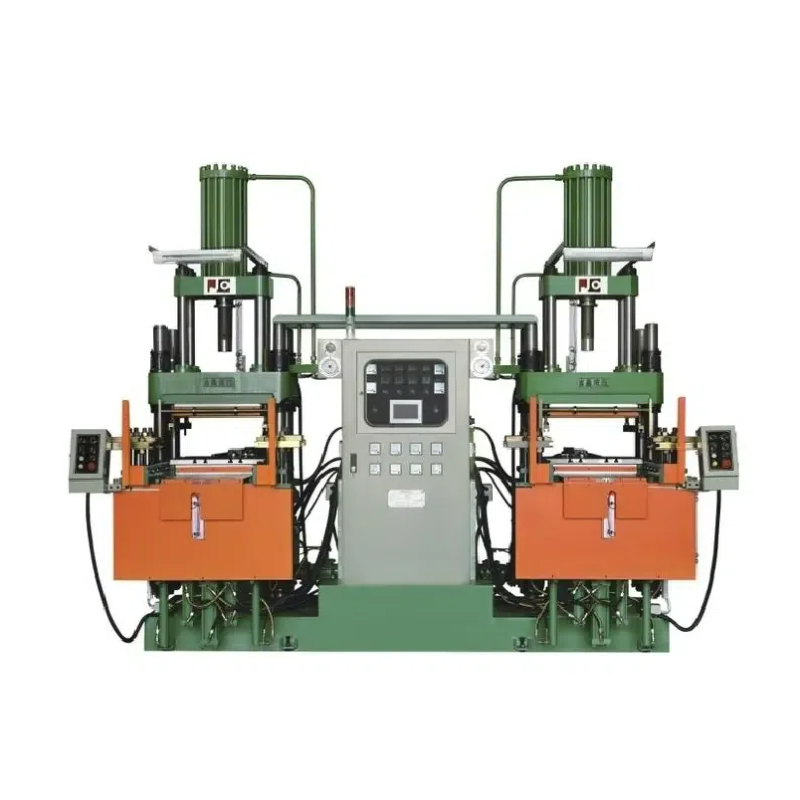
Machines equipped with real-time monitoring and closed-loop control can maintain consistent pressure, temperature, and timing throughout the molding cycle. Integration with PLC or SCADA systems allows for centralized monitoring of multiple machines, providing alerts for deviations and ensuring high repeatability. These features help minimize scrap, improve first-pass yield, and provide data for continuous process improvement.
Reducing downtime is essential for maximizing productivity. Maintenance-friendly machines feature accessible components, simple lubrication points, and clear service manuals. Availability of spare parts and responsive technical support ensures your production line remains operational. Choosing a machine with reliable after-sales service is just as important as its technical specifications.
The initial purchase price of a rubber machine is only part of the investment. Operational costs include energy consumption, downtime due to maintenance, tooling replacement, spare parts, and staff training. Machines designed for efficiency and reliability reduce these ongoing costs, making them more cost-effective in the long run.
Estimating return on investment involves more than comparing purchase prices. Evaluate metrics such as cost per part, expected production cycles, energy efficiency, and maintenance intervals. A slightly higher upfront investment in a machine with lower operational costs may pay off quickly, improving overall profitability and ensuring sustainable production.
Before fully accepting a machine, request trial runs with sample parts reflecting your actual production. Assess dimensional accuracy, surface finish, and material consistency. Document trial results to verify that the machine meets your specifications. This step is crucial for ensuring your rubber machine delivers the expected quality and performance.
Ensure your supplier provides clear warranty terms, defined service level agreements, and transparent lead times for spare parts. Reliable support helps prevent extended downtime and maintains consistent production schedules. Nanjing Kaishi provides full technical assistance and spare-parts supply, ensuring your machine operates reliably over its lifecycle.
Selecting the right rubber machine requires careful consideration of production volume, material requirements, machine specifications, automation options, and total cost of ownership. At Nanjing Kaishi Industry and Trade Co., Ltd, we offer a wide range of rubber injection molding machines suitable for applications from automotive and medical parts to electrical insulation components. Evaluate your requirements, request a sample-run, and explore our detailed specifications to make an informed choice. For more information on our rubber machines, spare-parts availability, and personalized guidance, contact us today. Our team will assist in finding the perfect solution for your production needs.
